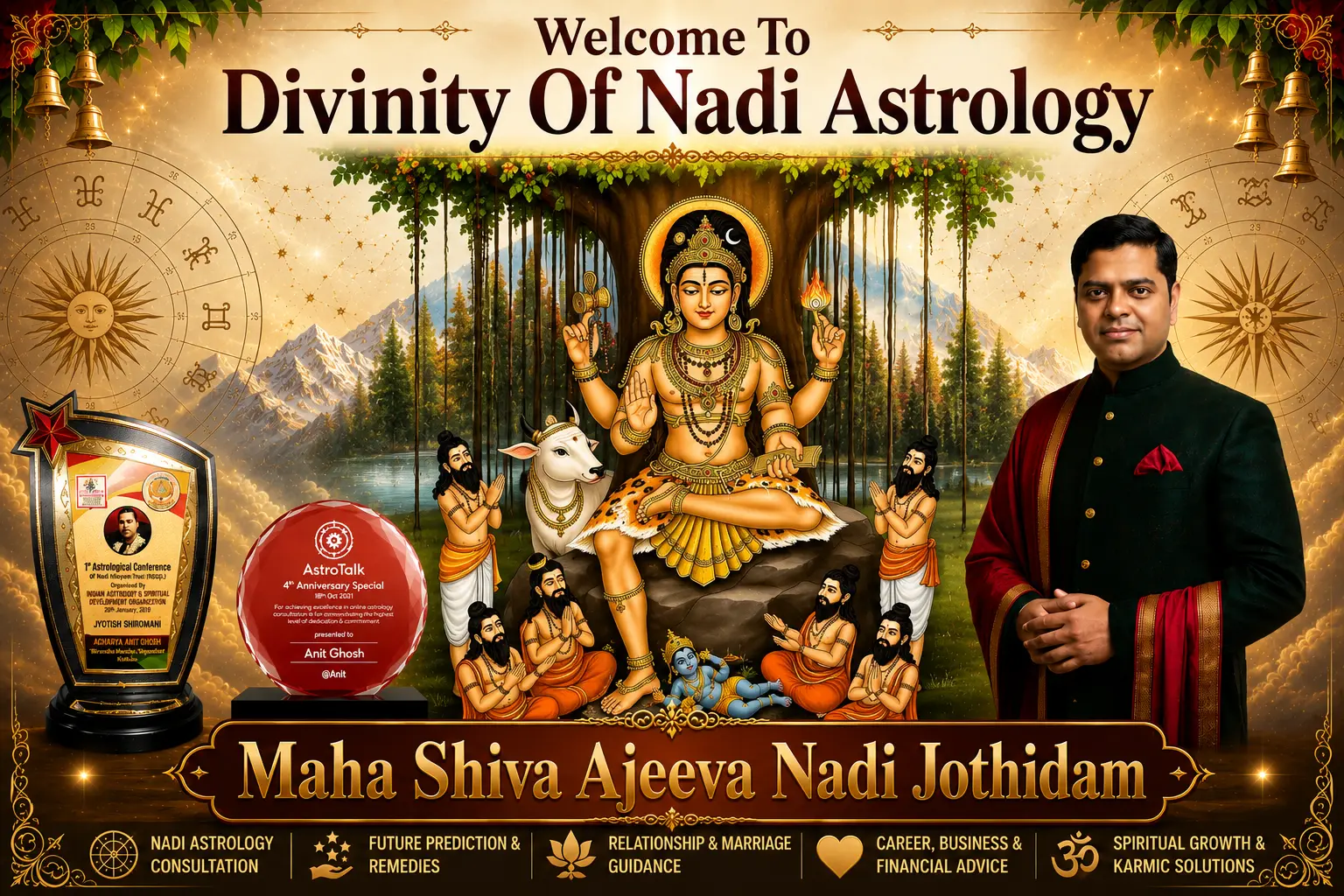

Authentic Shiva Nadi Astrology by Achaarya Anit
Achaarya Anit Expert in Ajeeva Nadi Sutram
Nadi Sankhatatwik&Vastu Ratnam.Get solutions through Siddha Pariharam Thulavaranam Sankalpa Sudhhi
Gurur Brahma Gurur Vishnu
Guru Devo Maheshwara II
Guru Saakshaat Para Brahma
Tasmai Shri Gurave Namaha II
At Divinity of Nadi Jyotish, the sacred science of Shiva Nadi Astrology helps uncover karmic patterns, life purpose, and hidden destiny. Through authentic Shiva Nadi Astrology consultation, seekers receive deep spiritual guidance for career, relationships, health, and prosperity. This ancient predictive science reveals the connection between cosmic timing and human life.
Under the guidance of Achaarya Anit, seekers receive authentic spiritual consultation rooted in traditional siddha knowledge and time-tested predictive methods. Each reading is designed to uncover life’s core patterns and provide meaningful direction for important decisions related to relationships, profession, finances, health, and spiritual growth.
What is Nadi Jyotish?
Nadi Joytish Kolkata Achaarya Anit helps in understanding destiny by studying the root of time and karmic patterns. Nadi means root, and Jyotish means the light of divinity that reveals past, present, and future.
This sacred science is based on precise sutras, planetary movements, and Nakshatra energies.
The word NADI means Root, which needs to do in
search of i,e to search for the root of anything is
called Nadi.
When this word connects with
Ayurveda it indicates the pulse i, e the unique
vibrating point which is indicating the channelized
life force in human body, on the other hand when it
is used in case of Jyotisha then it becomes the
search for subtlest Arc of Rashi in the entire Zodiac.
Jyotish means THE LIGHT OF DIVINITY(JYOTI+ISH)
Or the light of Nakshatra. Jyotish is the ultimate
divine tool to get insights in different context of life,
becoz it tries to study THE TIME.
When Nadi uses a
prefix before jyotish is called Nadi Jyotish or as
Nadi Jyothidam in South India.
Achaarya Anit is a powerful ancient Jyotish method used to understand your destiny, karmic patterns, health, marriage, career and spiritual path. This divine science is based on deep calculations and sutra-based predictions.
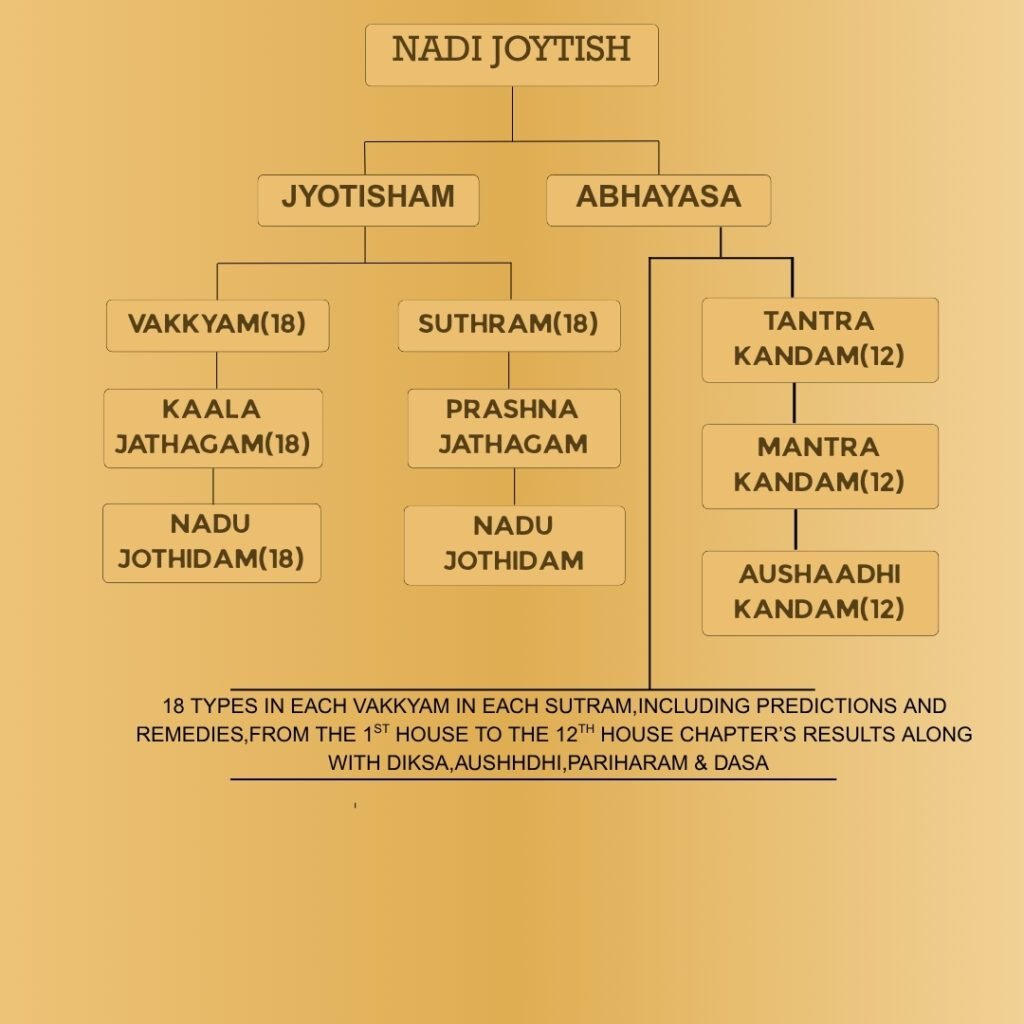
In Shiva Nadi Astrology by Achaarya Anit , Nadis are mainly divided into Jeeva Nadi and Ajeeva Nadi. Jeeva Nadi is known as the speaking Nadi used for readings, while Ajeeva Nadi focuses on Sutram, Vakkyam and Abhyasa Kandam with remedies.
Nadis are mainly divided into two parts: 1) Jeeva Nadi and 2) Ajeeva Nadi. Jeeva Nadis are known as the speaking Nadis, which are mainly used in Nadi readings by various Nadars (who read Nadi, called Nadar). This is also called “Siddhya Jeeva Nadi” because this process is absolutely Siddhi based (either of God or Spirit) technique.
Ajeeva Nadi has two segments: Jyotisham and Abhayasa (i.e., practical practice) Kandams. Jyotisham has two more sub-parts called Vakkyam and Suthram, both of which have three segments: Kaala Jathagam, Prashna Jathagam, and Nadu Jothidam.
On the other hand, the Abhayasa Kandam has three sub-parts called Tantra Kandam, Mantra Kandam, and Aushaadhi Kandam. In the case of some pre-written nadis (claimed to be written by various sages), these are also treated under the Vakkyam section, detailing the native’s life.
For this section, a thumb impression is required (right for male and left for female) to identify the specific Olai and to read the matter regarding the native’s entire life, which has already been narrated by various sages, written and collected by their disciples, and preserved through Olai Chauvadi (Palm Leaf Manuscript).
However, not everyone’s horoscope is available in this section.
Apart from the Palm Leaf theory, under the Suthram section, data of birth is required for predictions regarding the native’s life.
Sometimes predictions can also be made through Prashna. It is based on some composed formulas, sensibly provided by our ancient sages; you need to learn it properly from your Guru/Mentor.
It is said that 72 types of Nadis existed, among which 36 (18 Vakkyam and 18 Sutram) are Jyotisham, and the remaining 36 (12 Mantra + 12 Tantra + 12 Aushadhi) are Abhayasa. Nadis were mainly written either in Antadi Meter, Asiriyappa Meter, or Anustupa Meter.
Uses of Katapayadi Vargas (ancient tricks of reverse writing) are also found in various nadis. Mainly, Nadis were written in old Tamil (that language is called Vatthezetthu).
Nadi manuscripts are composed in the form of Tamil classical poetry called Venpa & Virutham. Mainly, Pambu Panchangam with Samvatsara Kaala was adopted to cast any native’s horoscope. Nowadays, Pambu Panchang is popularly known as Vakkya Panchangam (in South India only), which is nothing but a zonal version of Sri Surya Siddhanta method.
Nowadays, in Vaitheswaran Koil Temple (Thanjavur), Adyar Library (Chennai), Government Oriental Manuscript Library (Chennai), Swaraswati Mahal Library (Thanjavur), Mysore University Library (Mysore), etc. are the main places where the nadis are kept under surveillance by authorities. Apart from that, some old families are living in South India, Punjab, Banaras, Gujarat & Nepal, who also have some typical manuscript-based methods for practice, as they claim to be the descendants of various Sages.
Ajeeva Nadis have 16 divisions in total, including predictions and remedies, from the 1st house to the 12th house chapter’s results along with Diksha, Aushadhi, Pariharam & Dasa. In the Tamil lang
History & Divinity Of Nadi Jyotish
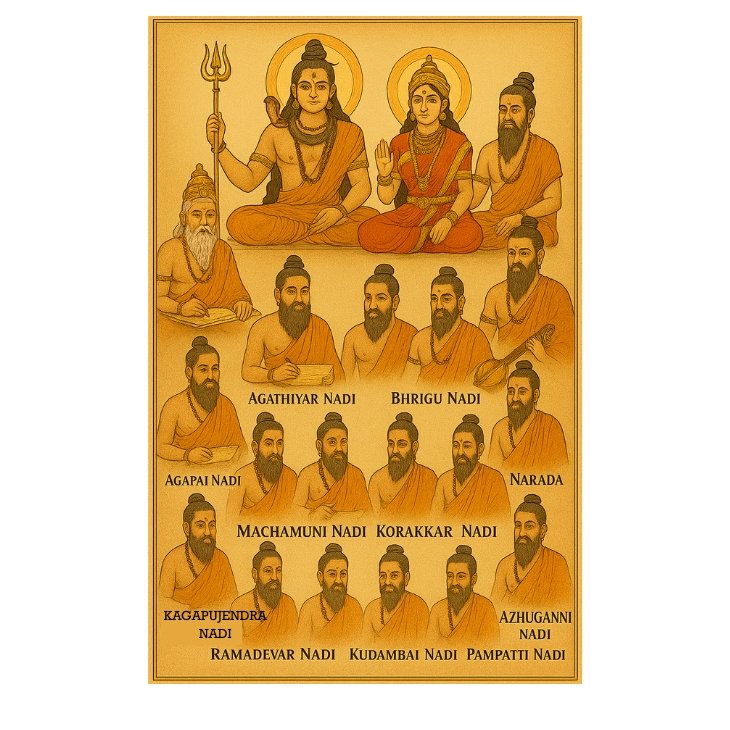
The divine knowledge of Nadi Jyotish Kolkata Achaarya Anit is believed to be revealed by Lord Shiva to Mata Parvati. Sage Bhrigu compiled this wisdom and created predictive systems used even today.
Later, many Siddhars of Tamil Nadu preserved this knowledge in palm leaf manuscripts.
According to our mythological data, this subject was invented and revealed by Lord Shiva to Mata Parvati, narrated by Lord Brahma, compiled by Sage Bhrigu (the Manas Putra of Lord Brahma), and spread to the world by Sage Narada (one of the greatest devotees of Lord Vishnu). Step by step, this process has been passed down from one sage to another as their disciple.
The first tradition started by Sage Bhrigu in the Satya Yuga (compiler of Bhrigu Samhita, the first-ever work on Jyotish Shastra).
Bhrigu compiled about 500,000 horoscopes and recorded the life details and events of various persons.
His compiled version…has formed a giant database for further research & studies for all. All Nadis & other branches of Indian Astrology have been derived from this.
27 Nakshatras and its various uses, 9 Planets and their all possible permutation & combination, all Vargas (which Bhrugu got from Lord Brahma) and its various uses, all types of Dashas and their uses, 12 Rashis and their values etc. everything was compiled & described by him through his classic, it is said that he has done this mammoth work with the help of Lord Ganesha and his formulation could have been erected up to 45 million horoscopes at that time.
Sage Bhrigu taught this art to his son Shukra and his other pupils. Bhrugu Nadi is a predictive part of his classic. This is the starting history of Nadi Jyotish.
It is said that after sage Bhrigu, 7 sages (Atri, Agastya, Vasistha, Narad, Songinar, Vishwamitra & Jaimini) have compiled their work on nadi, broadly known as Saptarushi Nadi. Else 18 siddhars (siddha purushas) of Tamil Nadu have also proceeded to intact this very matter.
Their nadis are named as;
Types of Nadi in Old Tamil (Vatthhezzetthu) by 18 sidhars;
1. Agathiyar Nadi
2. Bogar Nadi
3. Therayar Nadi
4. Nandhidevar Nadi
5. Thriumoolar Nadi
6. Konganar Nadi
7. Machamuni Nadi
8. Korakkar Nadi
9. Sattaimuni Nadi
10. Sundaranar Nadi
11. Ramadevar Nadi
12. Kudambai Nadi
13. Karuvoorar Nadi
14. Edaikadar Nadi
15. Azhuganni Nadi
16. Agapai Nadi
17. Kagapujendra Nadi
18. Pambatti Nadi
Ancient Wisdom of Shiva Nadi Astrology
Shiva Nadi Astrology is a divine branch of ancient astrology revealed through sacred siddha traditions. Unlike ordinary horoscope analysis, Shiva Nadi Astrology explores subtle karmic influences, planetary vibrations, and spiritual causes behind life events.
This sacred knowledge helps decode the connection between karma, planetary influence, and human consciousness. Through this process, one can gain clarity about recurring obstacles, delays, emotional struggles, and hidden strengths.
Achaarya Anit is an expert in Maha Shiva Ajeeva Nadi Jothidam and helps people through Prashna Nadi, horoscope analysis, birth time adjustment, Vastu rectification and Siddha Pariharam Thulavaranam.
At Divinity of Nadi Jyotish, every consultation aims to provide both prediction and transformation. The goal is not merely to forecast events but to empower individuals with awareness and spiritual remedies.
Why Choose Us
Thousands trust Divinity of Nadi Jyotish because our Shiva Nadi Astrology consultation combines ancient wisdom with practical remedies. Every session is personalized to help seekers overcome obstacles and align with positive energies.
Achaarya Anit is recognized by many seekers as a trusted Nadi astrologer and a leading spiritual guide. Those looking for the Best Astrologer in India often choose because of its authentic approach and traditional methods.
What makes Divinity of Nadi Jyotish different is the balance between traditional wisdom and practical guidance. The consultation process focuses on accuracy, ethical practice, and individualized solutions.
Achaarya Anit is an expert in Maha Shiva Ajeeva Nadi Jothidam and helps people through Prashna Nadi, horoscope analysis, birth time adjustment, Vastu rectification and Siddha Pariharam Thulavaranam.
Book Your Shiva Nadi Astrology Consultation Today
FAQ
Q: Why is Achaarya Anit considered among the Best Astrologers in India?
Achaarya Anit is known for authentic Nadi Jyotish, Shiva Nadi Astrology, accurate predictions, and personalized remedies, making him one of the Best Astrologers in India for marriage, career, finance, and spiritual guidance.
Q: Can I get online consultation from the Authentic Shiva Nadi Astrology by Achaarya Anit?
Yes, Achaarya Anit provides online astrology consultation across India and worldwide, helping clients receive guidance from a Authentic Shiva Nadi Astrology by Achaarya Anit.
Q. Why choose the Authentic Shiva Nadi Astrology by Achaarya Anit?
The Authentic Shiva Nadi Astrology by Achaarya Anit provides accurate predictions, personalized remedies, and spiritual guidance based on traditional Nadi Astrology principles.
Explore our Government Job Astrology consultation.
Read our detailed Karma Theory in Nadi Astrology guide.
Learn more about Marriage Prediction by Nadi Astrology.
Read our detailed Foreign Travel Prediction Astrology
Explore our Trusted Nadi Astrologer
Explore our Career Prediction Astrology
Explore our Best Astrology Consultation Services
Explore our Popular Nadi Astrologer Near Me – Trusted Guidance
Explore our Famous Nadi Astrologer in India
Explore our Nadi Jyotish Kolkata: Powerful Nadi Astrology Guidance
Our Services
Our consultation through Shiva Nadi Astrology provides guidance in major life areas:
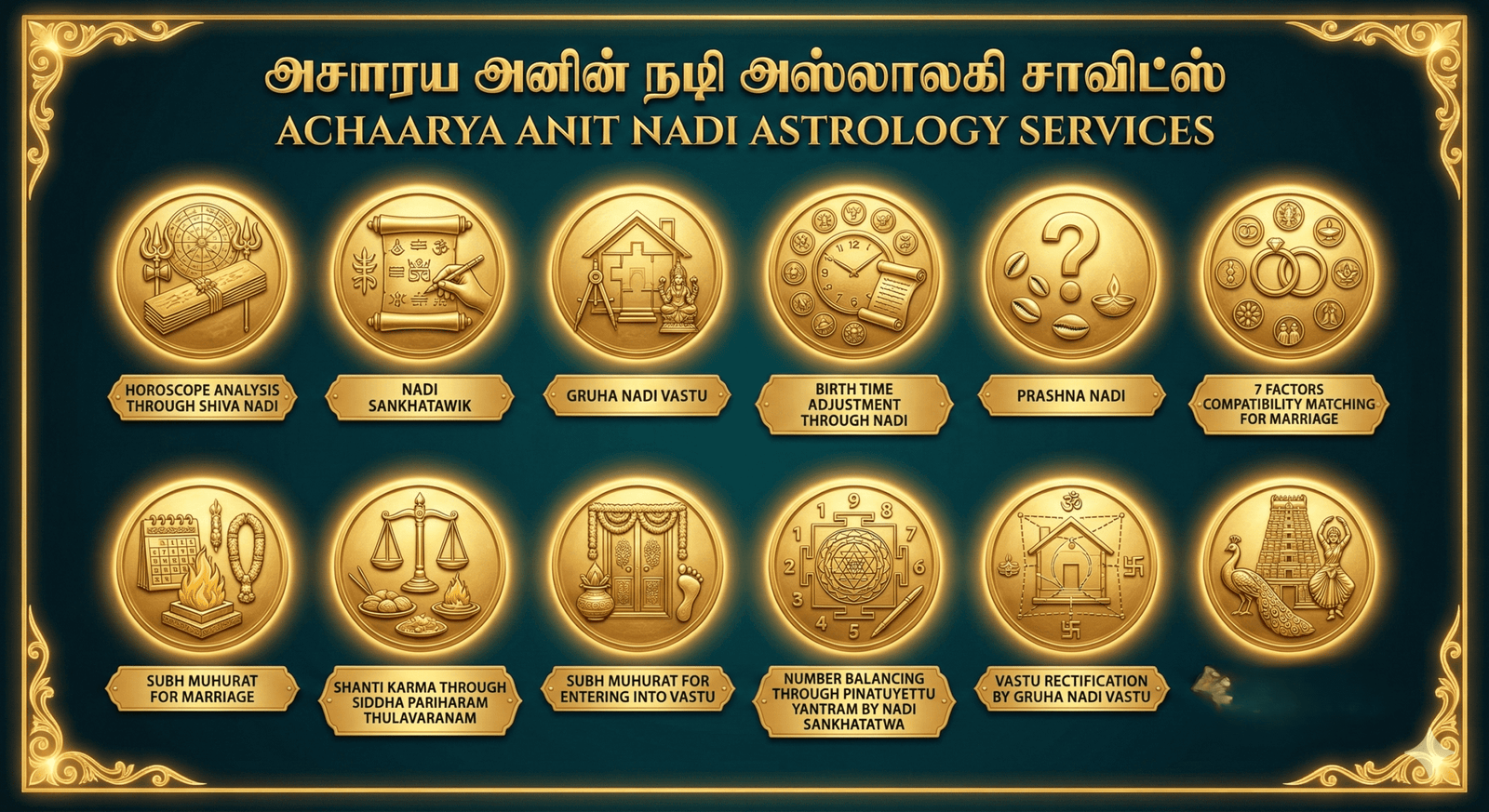
Horoscooe analysis through Shiva Nadi
Nadi Sankhyatatwik
Gruha Nadi Vastu
Birth time Adjustment through Nadi
Prashna Nadi
7 factors Compatibility Matching for marriage.
Sidhha Pariharam Thulavaranam
Subh Muhurat For Marriage.
Shanti Karma Through Sidhha Pariharam Thulavaranam.
Subh Muhurat For Entering into Vastu
Number Balancing Through Pinatuyettu Yantram By Nadi Sankhatatwa
Vastu Rectification By Gruha Nadi Vastu
Table of Contents

Achaarya Anit
65, Gostatala New Scheme Rd, Subhas Pally, Kamdahari, Kolkata, West Bengal 700084
Quick Links
Our Services
Vastu Rectification By Gruha Nadi Vastu
Number Balancing Through Pinatuyettu Yantram By Nadi Sankhatatwa
Subh Muhurat For Entering into Vastu
Shanti Karma Through Sidhha Pariharam Thulavaranam
Subh Muhurat For Marriage.
Sidhha Pariharam Thulavaranam
7 factors Compatibility Matching for marriage
Prashna Nadi
Birth time Adjustment through Nadi
Nadi Sankhyatatwik
Horoscooe analysis through Shiva Nadi
contact Us
Phone Number :- 9007513914/7003497518
What’sApp :- 9007513914
Mail id :- achaaryaanit.nadijyotish@gmail.com