Gurur Brahma Gurur Vishnu
Guru Devo Maheshwara II
Guru Saakshaat Para Brahma
Tasmai Shri Gurave Namaha II
Lessons From My Param guru
Powerful Karma Theory in Nadi Astrology – Prarabdha, Sanchita, Agami & Kriyamana Explained Through Houses, Transits and Real Charts
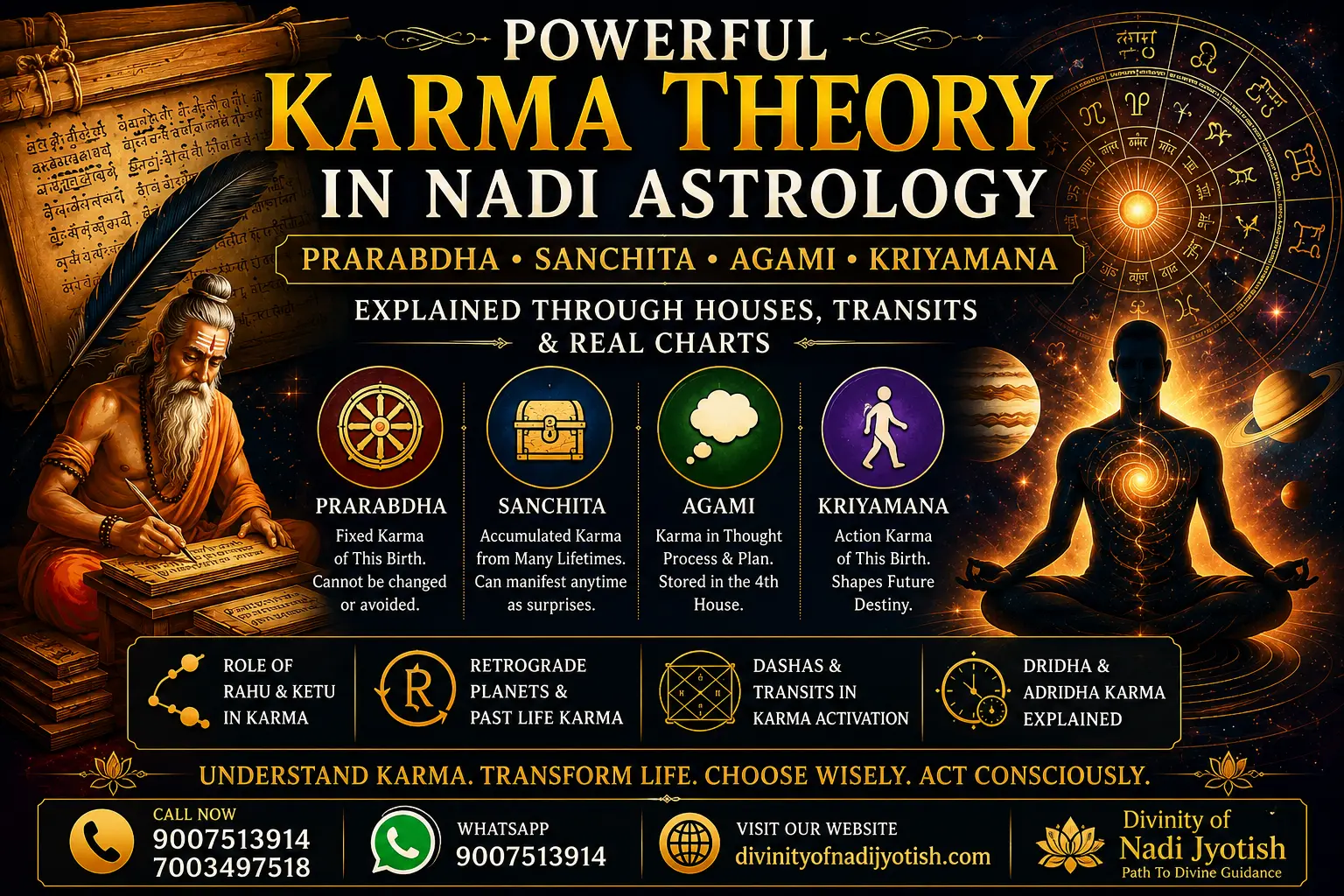
Nadi Astrology does not view life as random. Every event, delay, success, loss, and transformation is governed by karma, stored and released through specific houses (Bhavas), planetary significators, dashas, and transits.
The ancient seers classified karma in a deeply logical way so that an astrologer could clearly distinguish what must happen, what may happen, and what can be changed through conscious action.
This blog explains the Theory of Karma in Nadi Astrology using:
Prarabdha, Sanchita, Agami, and Kriyamana karma
House-based storage of karma
Role of Rahu–Ketu and retrograde planets
Difference between Dridha and Adridha results
How transits and dashas trigger karmic events
A practical chart-based understanding
.
Understanding Karma in Nadi Astrology
In Nadi Astrology, karma is the result of actions done across multiple births. These actions do not disappear; they are stored, processed, and delivered through the horoscope.
The horoscope is not just a chart of planets — it is a karmic ledger.
According to the karmic framework:
Janma Lagna (Ascendant) represents the present birth
9th house represents the past birth
5th house represents the future outcome
10th house represents current life actions
4th house acts as the storage house of karma
This house-based logic is one of the strongest foundations of Nadi Astrology.
The Four Types of Karma in Nadi Astrology
Nadi Astrology categorizes karma into four distinct types, each operating from specific houses and planetary mechanisms.
1. Prarabdha Karma – Fixed Karma of This Birth
Prarabdha karma is the portion of karma that must be experienced in the current lifetime.
It cannot be altered, avoided, or escaped.
Key Principles:
Represented strongly by the 6th house
Wherever the 6th lord goes, that house delivers unavoidable results
These results can be good or bad
Sudden health issues, unavoidable struggles, and fixed life situations often arise from Prarabdha karma
This explains why the 6th house, though a house of sickness and enemies, is also an Upachaya house — it grows and delivers results over time, sometimes unexpectedly.
2. Sanchita Karma – Stored Karma From Many Lifetimes
Sanchita karma is the accumulated karma from countless past lives.
Characteristics:
Can manifest anytime
Often appears as sudden surprises
Explains why a good person may suffer suddenly or a bad person may receive unexpected benefits
In Nadi Astrology:
Life primarily occurs through houses 1, 5, and 9
Actions belong to houses 2, 6, and 10
4th house is the general storage of karma
The storage of 10th house karma is found four houses away from the 10th
Sanchita karma explains unpredictable turns of destiny.
3. Agami Karma – Planned Karma (Thought Karma)
Agami karma is karma created at the level of intention and planning.
From the images:
“Agami karma is what I want to do — my plan — karma in thought process — stored in the 4th house.”
Key Insights:
Stored in the 4th house
Represents desires, intentions, unfulfilled plans
If an intention is not fulfilled in this life, it moves to the 12th house of the next life
The 12th house thus contains pending karmic desires
Agami karma explains why certain strong desires exist without clear reasons.
4. Kriyamana Karma – Action Karma of This Birth
Kriyamana karma refers to the actions actually performed in this lifetime.
Key points:
Governed primarily by the 10th house
Determines future birth conditions
Unlike Prarabdha, Kriyamana karma is under human control
Conscious choices can refine how karma unfolds
This is why:
“May we judiciously choose our actions.”
Kriyamana karma is the only karma fully in human hands.
Dridha and Adridha Karma – Certainty vs Uncertainty
Nadi Astrology further refines karma based on certainty of results.
Dridha Karma
What is definitely happening
Shown by Dashas
Fixed and unavoidable
Adridha Karma
What may or may not happen
Shown by Gocharas (Transits)
Dridha/Adridha
Some results partially fixed, partially flexible
This distinction prevents false predictions and explains why not all promised results materialize.
Role of Rahu and Ketu in Karma
Rahu and Ketu are described as 100% karmic planets.
Key observations from the images:
Regular transits of Rahu–Ketu indicate inflow and outflow of karma
Their effects often arrive like a “big bang”
They activate stored karma rapidly and intensely
Rahu brings unfulfilled worldly desires, while Ketu forces closure and detachment.
Vakri (Retrograde) Planets and Past-Life Karma
Any Vakri (retrograde) planet indicates:
Leftover work from a past life
Unfinished karmic responsibilities
Important rule:
While analyzing retrogrades, the 9th house (past birth Lagna) must be examined carefully
Retrograde planets do not deny results — they delay and repeat lessons.
How Events Are Triggered in Nadi Astrology
Karma becomes an event only when time supports it.
Events occur when:
A transiting planet crosses the exact natal degree of an event-signifying planet
Two event-signifying planets conjoin within one degree
A planet transits the cuspal degree of a relevant house
The Moon activates the event-signifying planets
The Antar-dasha lord transits a favorable Nakshatra
Without these triggers, karma remains dormant.
Dashas vs Transits – Who Decides What?
Dashas decide what is happening
Transits decide when it happens
Slow-moving planets:
Saturn
Jupiter
Rahu
Ketu
Fast-moving planets:
Sun
Moon
Mercury
Venus
Mars
An event occurs when fast planets activate slow planets connected to the karma.
Chart Illustration – Fixed Karma Example
The chart example shown in your images demonstrates:
6th house unalterable karma
Role of the 6th lord giving unavoidable results
How house relationships explain life events, losses, and gains
Why some outcomes cannot be changed even with remedies
This proves that astrology explains reality — not optimism or pessimism.
Why Nadi Karma Theory Is Extremely Accurate
✔ Separates fixed and flexible destiny
✔ Explains sudden events logically
✔ Avoids false promises
✔ Works even without exact birth time
✔ Integrates philosophy with prediction
Final Thoughts
Nadi Astrology teaches that fate and free will coexist.
Prarabdha must be experienced
Sanchita waits silently
Agami is born in thought
Kriyamana is shaped by action
Understanding karma through houses, dashas, and transits transforms astrology from belief into structured karmic science.
.
Recent Post

Achaarya Anit
65, Gostatala New Scheme Rd, Subhas Pally, Kamdahari, Kolkata, West Bengal 700084
Quick Links
Our Services
Vastu Rectification By Gruha Nadi Vastu
Number Balancing Through Pinatuyettu Yantram By Nadi Sankhatatwa
Subh Muhurat For Entering into Vastu
Shanti Karma Through Sidhha Pariharam Thulavaranam
Subh Muhurat For Marriage.
Sidhha Pariharam Thulavaranam
7 factors Compatibility Matching for marriage
Prashna Nadi
Birth time Adjustment through Nadi
Nadi Sankhyatatwik
Horoscooe analysis through Shiva Nadi
contact Us
Phone Number :- 9007513914/7003497518
What’sApp :- 9007513914
Mail id :- achaaryaanit.nadijyotish@gmail.com